
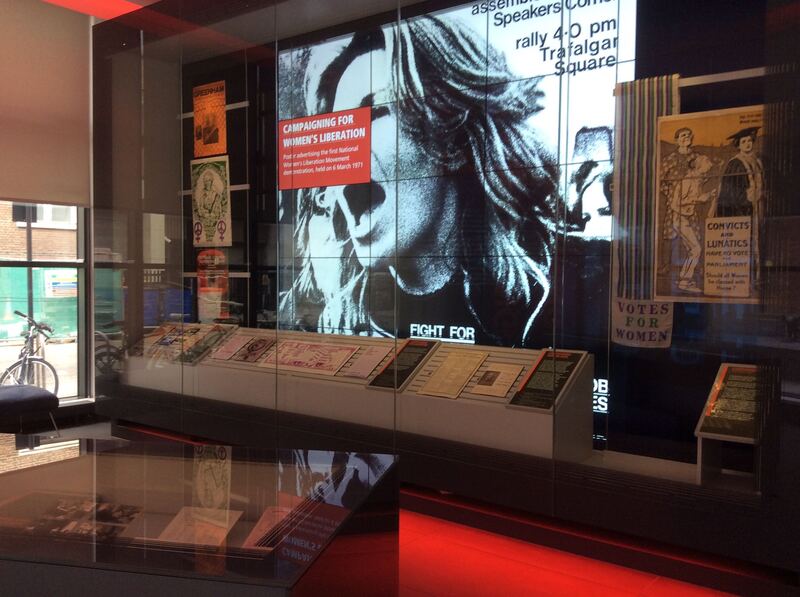
The Women’s Library, established by former suffragists in 1926 as the Women’s Service Library, is approaching its centenary. For almost half of that time, an independent group of Friends, building on earlier activity, has supported it through fundraising, donations, publicity, advice, and activities. The Friends had their origins during the upheavals and displacements of World War Two. The Library was then still owned and administered by the London Society for Women’s Service, which in 1953 became the Fawcett Society (and as such continues to flourish). In 1971, the Friends of the Fawcett Library was established, with the aims of fostering public interest in the Library, attracting gifts of books and manuscripts, and promoting the conservation of material. This body was formally constituted in January 1978, registered with the Charity Commission in January 1979, and continues today as The Friends of the Women’s Library following the renaming of the Library itself in 2002. (For more on the history of The Women’s Library and of the Friends, see our Timeline.)
AIMS
Throughout its history, the Friends’ aims, as stated in their constitution, have remained unchanged: ‘To advance the education of the public by the promotion, support, assistance and improvement of The Women’s Library’. Their remit is to raise money for the purchase of books and documents; to encourage donations to The Women’s Library of books, documents and other special collection materials; and to encourage the use of the Library for research. The Friends have also contributed towards the conservation of artefacts, paper works and audio recordings and the costs of microfilming, cataloguing and more recently digitising collections. The deployment of their funds has been and continues to be in consultation with the Library management of the day, and reflects the changing needs and priorities of whichever institution is the Library’s custodian.
DISBURSEMENTS
From the 1970s onwards, disbursements have been constant in both large and small amounts. Between 1994 and 1999, it was noted, the Friends donated a sum of around £100,000 to the then Fawcett Library and through strategic placing have made their gifts very effective. In 1994, for instance, a grant from the Friends, matched by funding from the Corporation of London Education Committee and London Guildhall University (formerly the City of London Polytechnic; later renamed London Metropolitan University after a merger with the University of North London), made possible the appointment of a Development Librarian to work up a strategic plan for what was then known as the Fawcett Library. This initiative led eventually to plans to rehouse the Library, achieved when it moved into its purpose-built site on Old Castle Street as the newly named Women’s Library in 2002. Ahead of the new Library’s opening, the Friends undertook to raise £50,000 for furniture and shelving. The Friends’ commitment to the continued existence of the Library was recognised when they were invited in 2012 to contribute to discussions of the criteria to be applied as London Metropolitan University (which could no longer sustain The Women’s Library) considered bids from institutions vying for new custodianship.
MEMBERSHIP
The Friends is a membership organisation, with administration overseen by an elected Executive Committee. Members are encouraged to put themselves forward for nomination to the Executive Committee at the Annual General Meeting or to propose others. In the past, Friends have joined other volunteers in making significant contributions to the work of the Women’s Library across a variety of needs: newspaper cutting, accessioning, indexing, archiving, conservation work, tour guiding at exhibitions, clerical and accounts work, as well as helping with the aftermath of flooding in the Fawcett Library, then housed in the basement London Guildhall University, in August 1994. Such activities are now in abeyance under the present arrangement with the London School of Economics. However, through its now well-established talks programme and occasional walks and outings, Friends and other participants come together for face-to-face and online meetings.
MODUS OPERANDI
The changing homes of The Women’s Library have required the Friends to be adaptable in where they meet and how they operate. Committee meetings and venues for talks have ranged from the University Women’s Club in London’s Mayfair in the early 1990s, to a stint at The Clarence pub in Mayfair in 1996, to The Women’s Library in its Wash House site on Old Castle Street after 2002. They are now hosted by LSE Library. Post-Covid, the Friends’ programme, like those of many institutions, takes place online as well as in person. Generally the sessions are organised as hybrid meetings, but are on occasion online or in-person only.
RECENT AND CURRENT ACTIVITY
Wherever based, the Friends of The Women’s Library have maintained a watching brief on the Library’s welfare, negotiating the terms of use of the collections, and of the funds the Friends dispense, and seeking ways to collaborate with the Library’s host. The Friends now support an essay prize for LSE students, continue to buy items through bidding at auction and purchases elsewhere, and maintain a programme of talks focussing on research materials in The Women’s Library dating from the Victorian era to the present day. Recent projects of the Friends include sponsoring the Time and Tide centenary project (2020-21) and taking on its website, and, in 2024, completing the Friends’ project of recording interviews with former members of the Movement for the Ordination of Women.
We warmly welcome the interest and support of new members. Come and join us!


